
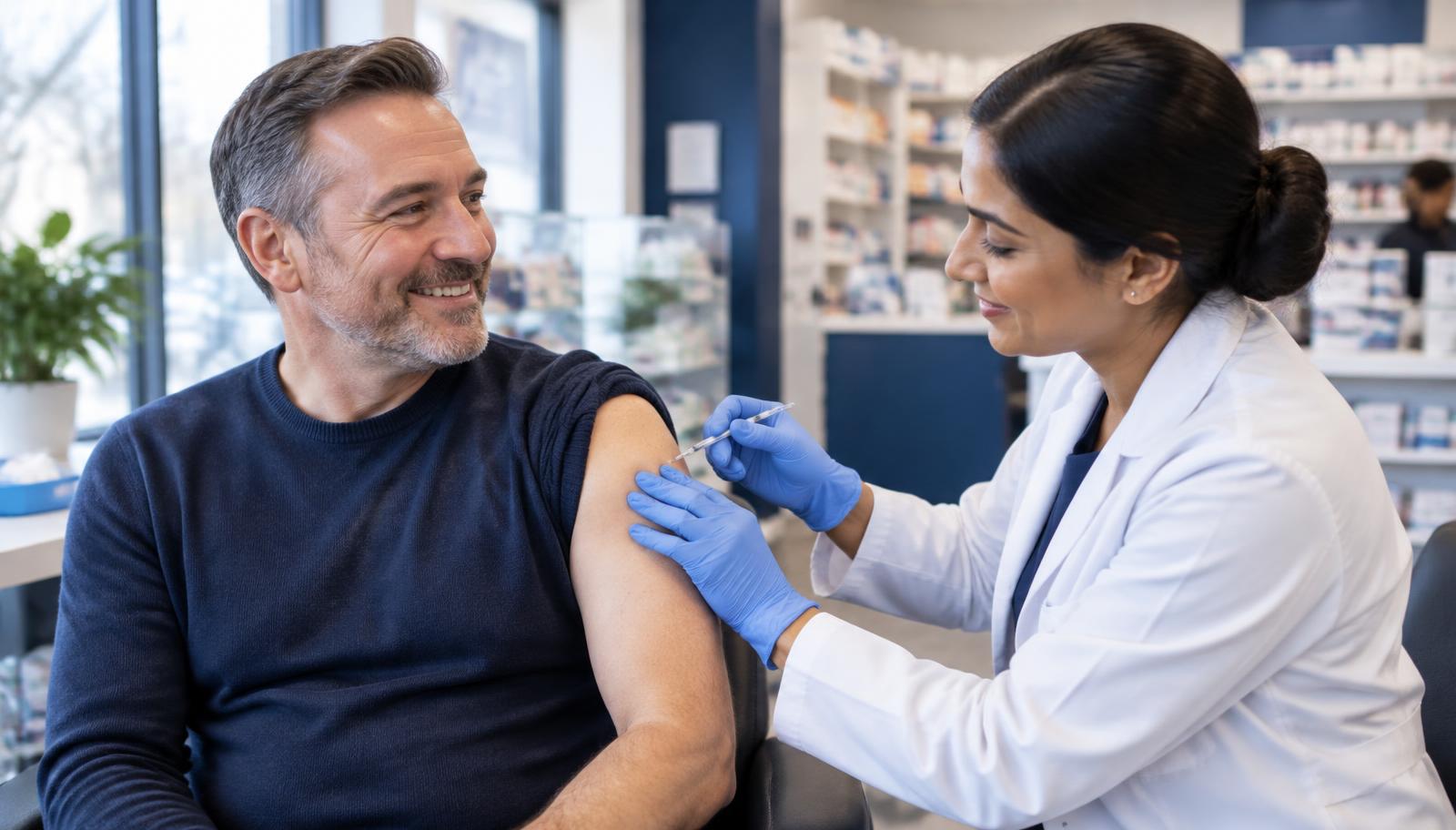
The pharmacies that fill flu and covid season bookings work on two fronts. First, they get existing patients booked in: SMS reminders two weeks before the season, in-branch conversations, digital and print signage, and free posts in local Facebook groups. Second, they use flu and covid as a gateway to new patients: Google Ads for people already searching, Meta Ads for local people who aren't, and a blog published at least 12 weeks early so it has time to rank. In a 12-month campaign we ran for a Welsh pharmacy chain, paid campaigns booked 188 flu vaccinations at £4.28 per acquisition.
Start before the season starts
The biggest mistake pharmacies make is treating flu season as an autumn event. By the time the national NHS campaign raises awareness, the pharmacies winning the most bookings locked their plans down months earlier. Content, booking links and opening hours should be ready well ahead, so that when demand arrives you are catching it rather than setting up.
It helps to think about the season as two separate jobs. The first is getting your existing patients booked in, the cheapest bookings you will ever get. The second is using flu and covid to bring brand-new patients through the door. They need different channels, so this guide covers them separately.
- Seasonal blog post published at least 12 weeks before the season
- Booking URL tested on your own phone
- Private price decided and shown on the page
- NHS and private eligibility copy drafted
- Google Business Profile: service listed, hours checked, photos added
- SMS reminder scheduled for two weeks before the season
- Staff briefed to mention vaccinations at the counter
- Digital screens and posters with QR codes pointing at the booking page
- Tracking live: bookings by source and cost per booking
Your season, week by week
| Period | What to focus on |
|---|---|
| June (12+ weeks before) | Publish your flu and covid blog post so it has time to rank in Google and be picked up by AI search |
| July–August | Lock vaccine supply and training, set your private price, build and test the booking page, draft NHS and private copy |
| Mid-August (2 weeks before) | Send SMS reminders to existing patients, update your Google Business Profile, put signage and QR codes up |
| September | First NHS cohorts become eligible from 1 September, switch on Google Ads and Meta Ads, post in local Facebook groups |
| October | All remaining NHS cohorts open up from 1 October, which is peak demand, so scale ads toward your best-performing locations |
| November | Keep ads running against remaining stock, chase no-shows, promote walk-in slots |
| December–January | Wind down, capture 'remind me next autumn' consent, run a post-season review while it is fresh |
Part 1
Get your existing patients booked in
Before spending anything on advertising, maximise bookings from the patients you already have. They know you, they trust you and many of them were vaccinated with you last year. Everything in this section is free or close to it.
SMS reminders two weeks before the season
Text messages are read far more reliably than email, which makes SMS the strongest way to reach your existing patient list. Send a reminder around two weeks before the season starts, with your booking link in the message, and a follow-up once the eligible cohorts open. Pharmacy SMS software such as PharmLogic makes this simple to schedule and send to the right patients.
Keep each message short: who is eligible, whether it is free or private, and one link to book. Two or three well-timed messages are plenty; more and you train people to ignore you. And add a simple "would you like a reminder next autumn?" question to your booking confirmation. That consented list grows every season, so you never start from zero.
Talk about it in branch
Nothing beats naturally bringing vaccinations up in conversation with patients already coming in: collecting a prescription, asking for advice, buying over the counter. In the lead-up to the season and throughout it, brief every member of the team to ask a simple question: "Have you had your flu jab booked yet?" It costs nothing, and it reaches people at the moment they are standing in your pharmacy.
Back it up with digital and print signage. Screens behind the counter, window posters and bag inserts with a QR code to your booking page work especially well, because they catch people waiting to be served with nothing else to look at.
Free local social media
Post on local community groups on Facebook and on your own organic social media pages. It's free. Local groups are where residents ask each other where to get things done, so a friendly post with your availability, price and booking link reaches people who already live near you. Post when the season opens, again when the October cohorts open, and whenever you add walk-in slots.
Part 2
Use flu and covid to win new patients
Flu and covid vaccinations are great gateway services. A patient who comes in for a jab sees your other services, meets your team and is far more likely to come back for travel health, ear wax removal or a consultation. That matters more every year as pharmacies reduce their reliance on NHS income and grow private services instead.
Winning new patients takes an optimised booking page first, then paid and organic channels used in the right order.
Separate NHS and private messaging
NHS-eligible patients and private patients are two different audiences, and they respond to two different messages. Eligible patients want to know if they qualify and whether it is free. Private patients (travellers, busy workers, anyone outside the cohorts) want to know the price, the wait and how quickly they can be seen.
There are really four bookings to plan for, not one. Each needs its own clear route on your site, so a patient never has to work out which one applies to them.
| Booking type | Who it is for | Cost to patient | What the page must say |
|---|---|---|---|
| NHS flu vaccination | Patients in the NHS eligible cohorts for the current season | Free | Who qualifies this year, from which date, and how to book or walk in |
| Private flu vaccination | Anyone outside the NHS cohorts, such as working adults or travellers | Paid (typically £15–£25) | The price, appointment times and how quickly they can be seen |
| NHS covid vaccination | Only the narrower groups eligible in the current campaign | Free | Current eligibility, campaign dates and a booking route (often via the national booking service) |
| Private covid vaccination | Anyone not eligible on the NHS, where your pharmacy offers it | Paid | The price, vaccine availability and whether it can be given alongside a flu jab |
Keep NHS and private on separate pages, or at least clearly separated sections with their own booking buttons. Mixing them confuses patients and risks implying a paid vaccine is free. Private covid vaccination is also a growing opportunity: NHS covid eligibility is much narrower than for flu, so many people who want a covid jab can only get one privately.
Eligibility rules also shift mid-season, so when a cohort changes, every live asset needs updating the same day: your website, your Google Business Profile, your ads, your SMS templates and any posters with a QR code. If you are not sure how to split the messaging, our pharmacy marketing page shows how we structure service campaigns around exactly this.
Price is part of the message, too. UK private flu jabs typically sell for £15–£25. Pharmadoctor's national price guidance is £15–£25, and large chains sit in the same window (£19.49 at Well, £21.95 at Boots), while some chains undercut with member-only early-bird offers below £10. Whatever you charge, show it on the page: hidden pricing is one of the top reasons people book elsewhere.
Have an optimised service page in place first
None of the channels in this guide work without an optimised service or landing page behind them. Every SMS, poster QR code, Facebook post and ad funnels into one page, so that page has to convert. Build it before you promote anything.
Make booking simple and easy. A flu and covid booking page needs: a booking button visible without scrolling, separate routes for NHS and private patients, the price for private flu and covid jabs, the option to book flu and covid together, walk-in times for people who prefer to just arrive, and a phone number for people who prefer to call.
Test it on your own phone before the season starts. If booking takes more than three taps, or the page does not make it obvious what happens next, people will simply book somewhere else, usually a chain with a smoother process. If your site needs work before the season, our web maintenance service keeps booking pages fast and up to date.
Start with Google: capture people already searching
Start where the demand already exists. In the UK, "flu jab near me" is searched around 12,100 times a month and "private flu jab" around 1,900 times, according to Semrush. Someone typing those words is not researching. They are deciding where to go. Google Ads geo-targeted to a few miles around each pharmacy, pointing at a booking page, maximise bookings from people who are already looking.
Pair the ads with local search fundamentals: a complete Google Business Profile with the vaccination service listed, real photos, current hours and fresh posts, plus a dedicated flu clinic page rather than a mention buried on a services page.
The numbers back this up. Across a 12-month campaign we ran for a Welsh pharmacy chain, paid campaigns booked 188 flu vaccinations at an average acquisition cost of £4.28 each, the lowest of any service, alongside 353 travel health patients, 191 ear wax removals and 97 aesthetics consultations: 829 new private patients in total. You can see the full breakdown in our pharmacy case study.
| Service | New private patients (12 months) | Avg cost per acquisition |
|---|---|---|
| Travel health | 353 | £11.24 |
| Ear wax removal | 191 | £12.20 |
| Flu vaccinations | 188 | £4.28 |
| Aesthetics | 97 | £14.80 |
| Total | 829 | £4.28–£14.80 across services |
Flu vaccinations came in at roughly a third of the cost of the next cheapest service, which is exactly why they work so well as a gateway. We run Google Ads campaigns built specifically for healthcare services like these.
Meta Ads: reach local people who aren't searching yet
Plenty of people intend to get a flu jab but never search for one, until they see a local pharmacy offering it. Meta Ads on Facebook and Instagram reach people by location, so you can show your service to everyone within a few miles of each branch. Once they see a pharmacy near them offering the jab at a clear price, many simply come in.
Because you are reaching people before competitors bid against you in search, cost per conversion on Meta is often lower than on Google. Keep the creative simple: the service, the price, the location and a booking link. Refresh it when new cohorts open.
Plan a blog 12 weeks ahead for SEO and AI search
Publish a flu and covid page or blog post at least 12 weeks before the season starts. New content takes time to be crawled, indexed and trusted by Google, so a post written in September is usually too late to rank for that season. Written in June, it has the summer to build visibility before demand peaks.
The same content now feeds AI search: tools like Google's AI Overviews, ChatGPT and Perplexity that answer questions directly. This is often called GEO (generative engine optimisation). To be cited, answer the question clearly at the top, include your location, price, eligibility and booking details, and keep facts up to date. A well-structured page works for both traditional search and AI answers, and keeps working every season you update it.
Measure, then scale
Track bookings, track where they came from, and know what each one cost you to acquire. Acquisition cost is the number that decides whether scaling makes sense. A campaign bringing vaccinations at £4–£5 each deserves more budget, while one at £15 each needs its targeting reviewed before you spend more. Watch no-shows and walk-in conversion as closely as ad spend.
There are other ways to promote flu and covid vaccinations, but these are the ways we've seen the leading flu and covid clinics fill up: book your existing patients first, then use the season to win new ones.
Frequently asked questions
When should pharmacies start promoting flu vaccinations?
Publish your flu and covid blog post at least 12 weeks before the season so it can rank, send SMS reminders to existing patients around two weeks before, and switch on Google and Meta Ads as the NHS cohorts open from 1 September. Booking pages and your Google Business Profile should be ready before any of it goes out.
How much does it cost to acquire a flu vaccination patient through paid ads?
It varies by location and competition, but in a 12-month campaign we ran for a Welsh pharmacy chain, flu vaccinations were acquired at an average of £4.28 each through paid campaigns. That figure is an acquisition measure, not the total cost of running the campaign. Compare your cost per booking against the value of the appointment to decide whether to scale.
How much should I budget for ads to push my flu and covid service?
We recommend £5 to £10 per day per platform, depending on local search volume and the level of competition in your area. Start at the lower end on Google Ads and Meta Ads, run through the whole season rather than switching on and off week to week, and move budget toward whichever platform is bringing bookings at the lowest cost per appointment.
Can pharmacies advertise private flu jabs?
Yes. Pharmacies can advertise both NHS and private vaccination services, provided advertising stays accurate and separate: do not imply the vaccine is free for patients who are not NHS-eligible, keep eligibility statements up to date, and avoid guarantees about protection or outcomes. Follow ASA and GPhC advertising guidance, and update every live asset when eligibility cohorts change.
How can pharmacies get more covid booster bookings?
Covid booster demand is smaller and more cohort-driven than flu. UK search volume for "covid booster pharmacy" is low, around 20 searches a month. Focus on reaching eligible existing patients directly through SMS, in-branch conversations and signage, keep eligibility messaging current, and fold covid bookings into the same booking page as flu so patients can book both in one visit.
What is the best marketing channel for flu jabs?
Split it in two. For existing patients, SMS reminders, in-branch conversations, signage and local Facebook groups are the cheapest wins. For new patients, start with Google Ads to capture people already searching, add Meta Ads to reach local people who aren't, and publish a blog 12 weeks ahead for SEO and AI search. No single channel fills a diary on its own. The combination does.